
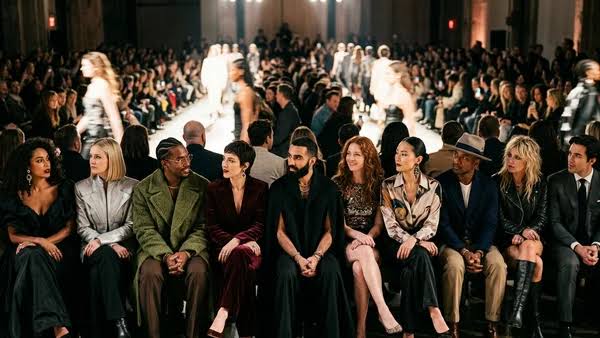
There was a time when the fashion show was the fashion show and the front row was simply where important people sat. Those days are long gone. At New York Fashion Week, the runway may still be where designers reveal their collections, but the front row has quietly become its own form of fashion theater. The clothes being worn by the celebrities watching the show can generate almost as much conversation as the clothes walking down the runway.
And this season, the competition for attention is particularly strong.
New York Fashion Week’s Spring/Summer 2027 shows are turning Manhattan into one giant moving mood board, with designers presenting new collections while celebrities arrive dressed for their own close-up. The official NYFW schedule began September 10 and runs through September 15, featuring roughly 70 runway shows and designer presentations.
But if you have been watching the celebrity arrivals, you already know there is another show happening at the same time.
Tate McRae, Gabrielle Union, Amanda Seyfried, Elle Fanning and a parade of other recognizable women have helped turn the seats outside the runway into another place to discover what fashion is about to become. The result is an entertaining little competition that happens every Fashion Week: Which outfit are we actually going to remember?
Sometimes, the answer is on the runway.
Sometimes, it is sitting three rows back.
That is the strange power of celebrity fashion in 2026. A designer can spend months developing a collection, carefully selecting fabrics, constructing silhouettes and creating an entire visual world, only for a celebrity’s outfit to become the image that dominates social media the next morning.
It does not necessarily mean the celebrity look is better than the collection. It means the two are now part of the same conversation.
The front row has become a translation device.
Designers create the clothes. Celebrities show audiences how those clothes might exist in the real world.
That is one reason Elle Fanning’s appearance at Coach has already become one of the season’s memorable examples. For the brand’s Spring 2027 show and 85th anniversary celebration, Fanning wore a deliberately dramatic combination of a red leather skirt, a black blouse, black pumps, a beret, a white Coach bag covered in stars and a leopard-print coat.
It was not exactly a case of quietly blending into the seating arrangement.
Fanning’s look seemed to understand the assignment immediately: if Coach was throwing an anniversary party, she was going to dress like she had been invited to the fashion version of a very stylish after-party.
The leopard print added attitude. The red leather created a strong visual center. The beret introduced a little Parisian character. The lingerie-inspired styling underneath kept the look from becoming too polished. Put everything together and it became the kind of outfit that practically asks to be photographed.
And that is precisely what happened.
Fanning’s look was covered as one of the standout celebrity moments of the opening days of NYFW, with fashion publications highlighting the deliberately mixed aesthetics of the outfit.
The interesting thing is that Fanning did not simply wear the Coach look exactly as it might have appeared on a model.
She interpreted it.
That distinction is becoming increasingly important.
Celebrity styling works best when the person wearing the clothes does not disappear inside the designer’s vision. The outfit should still feel connected to the brand, but it should also feel like something that belongs to the individual.
Amanda Seyfried offers another example of how the front row has become an important part of the overall fashion narrative. Her NYFW appearance has been included among the season’s notable celebrity front-row moments, alongside stars such as Elle Fanning and other major names from film, music and television.
Seyfried has an advantage that many celebrities do not: she can make relatively classic styling feel interesting simply through proportion, texture and attitude.
That matters because Fashion Week is not always about wearing the loudest outfit in the room.
Sometimes the smartest look is the one that knows when to stop.
The current season is full of contrasts like that. Designers are playing with minimalism, Americana, romantic dressing, tailoring, texture, color and nostalgia, creating an environment where celebrities have plenty of directions to choose from. Michael Kors has leaned into sculptural shapes and vivid details, Calvin Klein has returned to a sleek minimalist language, while Ralph Lauren is exploring romantic interpretations of American style.
That variety is what makes the front row so entertaining.
There is no single uniform.
One celebrity might arrive in something sharp and architectural. Another might choose soft tailoring. Someone else might go completely maximalist. Another might look as though she walked out of a 1990s photograph.
And somehow, they all belong to the same week.
Gabrielle Union is another name that illustrates just how broad the celebrity-fashion relationship has become. Her presence at New York Fashion Week places her within a front-row culture that increasingly brings together actresses, musicians, athletes, models and fashion personalities.
Union has long understood the value of fashion as part of celebrity identity. She is not simply someone who gets dressed for an event. Her fashion appearances have become another extension of her public image, which is exactly why a Fashion Week appearance can carry more weight than a standard celebrity sighting.
The same principle applies to Tate McRae.
Her presence represents the growing overlap between music and fashion. Pop stars have become some of the industry’s most influential style personalities because their fashion choices are connected to everything else they do: music videos, performances, tours, social media, beauty campaigns and red-carpet appearances.
When a singer arrives at Fashion Week, she is not just attending a show.
She is reinforcing an aesthetic.
That can make the front row feel like an unofficial extension of the runway.
The designers may be presenting the future of fashion, but celebrities are showing the audience how that future might look when it leaves the catwalk.
This is also why photographers outside the shows have become just as important as photographers inside them.
The moment a celebrity steps out of a car, walks toward a venue or pauses for cameras, the outfit becomes public. It can be photographed from every angle. Within minutes, the look can be circulating online.
The runway collection might have 40 or 50 looks.
The celebrity may have one.
But that one look can travel faster.
It is a strange equation, but it works.
A runway look asks you to consider an entire collection. A celebrity look asks you to imagine yourself in the outfit.
That is a powerful difference.
When someone like Elle Fanning wears a red leather skirt with a leopard-print coat, the conversation immediately becomes practical as well as aspirational. Could the skirt work with a different jacket? Is leopard print returning? Are berets suddenly interesting again? Could a red leather piece become the centerpiece of an otherwise simple wardrobe?
Celebrity fashion turns runway language into personal wardrobe questions.
And that is why the front row can sometimes influence fashion more directly than the runway itself.
Of course, there is an enormous amount of strategy behind these appearances.
Celebrity outfits rarely happen by accident. Stylists, designers, publicists, makeup artists, hairstylists and brand teams can all be involved. A celebrity may be wearing a look directly from the designer’s latest collection, a custom piece, a runway sample or a carefully selected archival item.
Every detail can be deliberate.
The shoes.
The handbag.
The jewelry.
The hair.
The makeup.
Even the decision to wear a coat over the outfit or leave it off can change how the final photographs look.
And then comes the most important part: timing.
Fashion Week is a short window in which the world is paying unusually close attention to clothes.
That means an outfit does not have to be revolutionary to be successful.
It just needs to be memorable.
The current NYFW season is already proving how quickly those moments can accumulate. Vogue’s running front-row coverage includes a constantly changing list of celebrities attending shows throughout the week, with Elle Fanning among the early standouts. Other fashion publications are similarly tracking the celebrity arrivals as carefully as the collections themselves.
This creates a fascinating feedback loop.
Celebrities attend shows because they want to be part of the fashion conversation.
Fashion houses invite celebrities because their presence generates attention.
Photographers capture the celebrities.
Fashion publications analyze the looks.
Fans react online.
And suddenly, the celebrity becomes part of the marketing ecosystem surrounding the collection.
Nobody needs to officially announce that the front row is a runway.
The internet has already decided.
There is also something wonderfully unpredictable about it.
The front row can produce a surprise. Someone arrives wearing an unexpected silhouette. An actress known for minimalist dressing suddenly embraces color. A singer turns up in something dramatically theatrical. A celebrity who usually plays it safe chooses the most daring look of the week.
Those are the moments people remember.
Fashion needs that element of surprise.
If everyone arrived wearing the same predictable version of luxury, Fashion Week would quickly become boring.
New York’s energy helps prevent that.
The city itself encourages experimentation. There is something about walking through Manhattan during Fashion Week that makes ordinary clothing feel like part of a larger performance. Outside a show, a simple blazer can suddenly look editorial. A pair of sunglasses can become a styling statement. A vintage bag can attract as much attention as a designer handbag.
The entire street becomes part of the show.
That is especially true this season as fashion houses continue balancing nostalgia with newness. Ralph Lauren is revisiting American fashion history, Coach is celebrating its 85th anniversary, Calvin Klein is exploring minimalist codes and other designers are experimenting with their own versions of familiar references.
The celebrities arriving at those shows are doing something similar.
They are taking recognizable fashion ideas and making them personal.
And that may be the real reason the front row has become so influential.
The runway tells us what designers want fashion to look like.
The front row tells us how culture wants to wear it.
That distinction is important.
Fashion is not finished when a model reaches the end of the runway. The clothes still need to enter the public imagination. They need to be photographed, discussed, copied, adapted and eventually worn.
Celebrity style helps that process happen.
A memorable celebrity look can make a silhouette suddenly feel desirable. It can revive interest in a color. It can make an accessory unexpectedly popular. It can remind people that a particular designer exists.
And sometimes, it can make people completely forget what collection the celebrity was supposed to be watching.
That is the risk designers probably accept when they invite famous people into the front row.
They are creating another stage.
And stages attract performers.
This year’s NYFW has plenty of them.
Tate McRae brings pop-star energy. Gabrielle Union brings years of fashion credibility. Amanda Seyfried brings polished Hollywood elegance. Elle Fanning brings a willingness to play with fashion and push an outfit beyond the obvious.
Different women.
Different aesthetics.
Different ways of making the same city feel like a runway.
That is what makes the celebrity front row so much fun to watch.
The fashion show may last twenty minutes.
The celebrity outfit can last online for days.
And while designers will ultimately be judged on the collections they create, the stars sitting in those famous front-row seats are helping determine which images survive the week.
So yes, New York Fashion Week still belongs to the designers.
But this season, the front row has made a very convincing argument that it deserves its own runway.
Because sometimes the most interesting fashion moment is not the model walking toward you.
It is the celebrity sitting still, waiting for the show to begin, and somehow becoming the person everyone is watching.
References
Vogue — Every Celebrity on the Front Row at NYFW Spring 2027
ELLE — How Elle Fanning Got Ready for Coach’s Spring 2027 Show
W Magazine — Elle Fanning’s Coach NYFW Look
Harper’s Bazaar — Celebrity Front-Row Looks at NYFW Spring/Summer 2027
Leave a Reply