
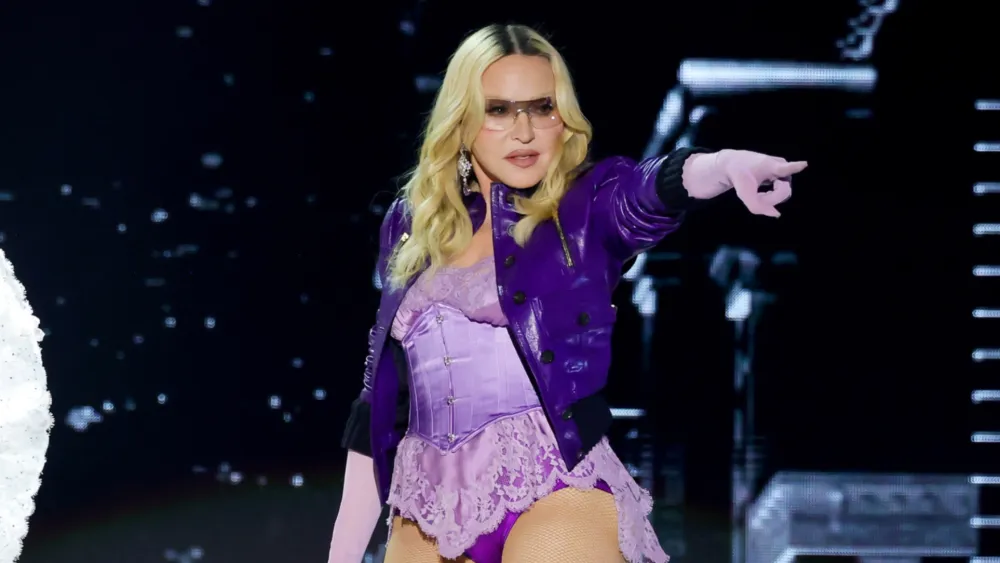
When Madonna appeared at the Coachella Valley Music and Arts Festival in a striking archive-inspired look, the reaction was immediate—and predictably divided. Within minutes, social feeds turned the outfit into a cultural talking point, reigniting a familiar debate in fashion: when does archival styling feel iconic, and when does it start to feel overexposed?
The look itself tapped directly into Madonna’s long-standing relationship with reinvention through fashion. Throughout her career, she has consistently used clothing not just as styling, but as narrative—pulling from past eras, subcultures, and runway history to construct evolving visual identities. This Coachella appearance continued that tradition, drawing on vintage references that felt intentional, layered, and deeply referential.
But in today’s attention economy, archival fashion carries a different weight than it once did. What used to feel rare and editorial now circulates instantly across platforms. As a result, the line between homage and repetition becomes harder to define. For some viewers, Madonna’s look felt like a powerful continuation of her legacy—proof that she still understands how to command visual conversation. For others, it felt like a familiar formula reintroduced into an environment that constantly demands novelty.
This tension is what made the moment trend so quickly. Fashion discourse in 2026 is no longer limited to runway reviews or magazine spreads—it unfolds in real time across social platforms. Every detail is dissected: the reference points, the styling choices, the cultural timing. A single look can generate thousands of micro-interpretations within hours, each shaping how the moment is remembered.
What complicates the conversation further is Madonna’s own influence on the very idea of archival fashion as cultural currency. Long before “vintage” became a mainstream aesthetic strategy, she was already repurposing and recontextualizing past styles to create new visual narratives. In that sense, her Coachella look isn’t a departure—it’s a continuation of a methodology she helped normalize in pop culture.
Still, the debate reflects a broader shift in how audiences engage with fashion moments. There is increasing sensitivity to repetition, especially in a digital environment where visual ideas spread quickly and are constantly recycled. What once felt groundbreaking can now feel familiar faster than ever, not because it has lost meaning, but because the speed of cultural circulation has increased.
At the same time, archival fashion remains powerful precisely because of its references. It connects eras, evokes memory, and situates the present within a longer cultural timeline. Madonna’s look operates in that space—between recognition and reinterpretation. Whether it is seen as iconic or overplayed often depends less on the outfit itself and more on how audiences are choosing to engage with repetition in modern culture.
Ultimately, the reaction to Madonna’s Coachella appearance reveals less about the outfit and more about the moment we’re in. Fashion is no longer static or seasonal—it is instantaneous, debated, and endlessly recontextualized. And in that environment, even archival style doesn’t sit still. It becomes conversation, controversy, and content all at once.
Leave a Reply